
Why AI and digital transformation must fix trust before they fix process in the Caribbean insurance market.
Caribbean insurance executives are asking the right questions about systemic risk, ageing populations, climate exposure, healthcare inflation, and constrained capital markets. These are real, structural challenges that deserve serious strategic attention. But underneath every actuarial model, every risk matrix, and every transformation roadmap, there is a more fundamental problem that the industry rarely names directly: a significant share of the people this sector exists to protect have already decided it is not for them.
They are not wrong to be sceptical. They have watched premiums leave their accounts for years and received little in return, no communication, no value, no relationship. From the outside, insurance looks like a bet that most people lose. That is not a knowledge gap. It is a design and trust deficit. And until Caribbean insurers address it, no amount of digital transformation will move the needle where it matters most.
The Real Protection Gap Is a Trust Gap
The numbers make the scale of the problem visible. According to IDB Invest, insurance penetration across Latin America and the Caribbean reached just 3.1% of GDP in 2023, well below the global average of 7%. The regional protection gap is estimated at USD 301.3 billion. That figure does not represent people who cannot afford insurance. It largely represents people who have not been given a compelling enough reason to buy it.
Across the region, SMEs represent 99.5% of all firms and employ approximately 60 million people, yet an estimated 85% lack adequate insurance coverage (IDB Invest, 2024). The Caribbean insurance market is projected to reach gross written premiums of USD 32.27 billion in 2024, dominated by life insurance (Statista, 2024). The market exists. The demand conditions exist. What is missing is a distribution model and a product experience that earns the trust of people who have been underserved for decades.
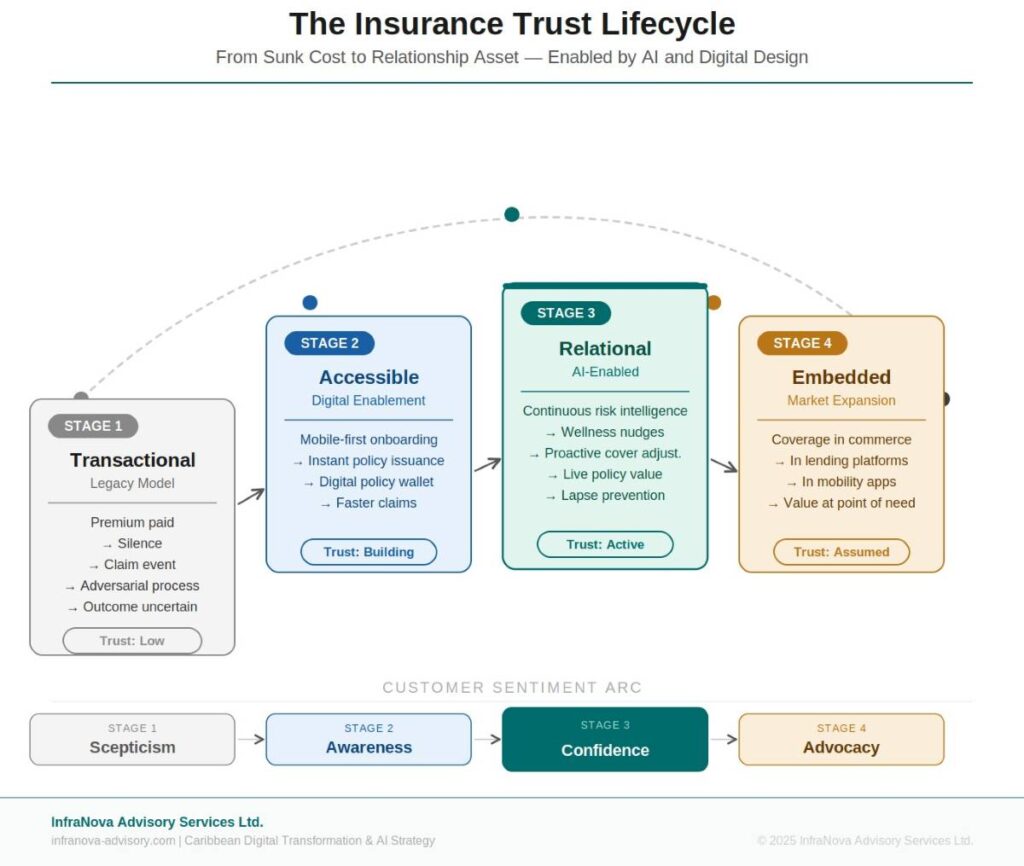
The average Caribbean policyholder pays each month and hears nothing back until something goes wrong, at which point they must prove their loss, navigate the claims process, and wait. That is not a relationship. It is a transaction built entirely around the insurer’s needs. AI and digital transformation offer a genuine opportunity to change that architecture from the ground up.
The Sunk Cost Stigma Is a Design Flaw, Not a Cultural One
It is tempting to frame low insurance uptake as a cultural or financial literacy problem. That framing lets the industry off the hook. When people describe insurance as money gone with nothing to show for it, they are describing an experience, not a misunderstanding. The product was not designed to deliver continuous value. It was designed to process claims. And when claims are rare, the relationship goes quiet.
AI changes this fundamentally. Artificial intelligence, applied responsibly and with appropriate governance, enables insurers to deliver value between events, not only after them. Wellness scoring tools that help policyholders manage health risks. Personalised risk alerts tied to weather data, driving behaviour, or property conditions. Real-time policy dashboards that show what coverage is active and what it would pay in a given scenario. These are not gimmicks. They are the building blocks of a relationship that justifies the monthly premium in human terms, not contractual ones.
Governance matters here as much as innovation. AI governance and responsible AI deployment in the Caribbean context requires that these tools are transparent, explainable, and culturally appropriate. Regional regulators and industry bodies will need to develop frameworks that balance digital innovation with consumer protection and insurers who build those frameworks early will carry a significant competitive advantage.
The New Customer Lives Behind a Screen and Expects Instant
The next wave of Caribbean insurance customers is not walking into a broker’s office. They are entrepreneurs managing a small business from a smartphone in Port of Spain or Kingston. They are gig workers with variable income who cannot commit to annual or monthly premium cycles. They are young professionals who have never spoken to a financial adviser and conduct every financial transaction digitally. They have short attention spans for products that require lengthy applications, paper signatures, or a follow-up call to understand what they have purchased.
This is not a problem, it is a design brief. Embedded insurance, micro-coverage products, usage-based policies, and instant digital underwriting are not fintech novelties. They are the distribution architecture for an underserved majority that already holds the most important commercial asset in the region: a smartphone and mobile data.
IDB Invest reports that widespread smartphone adoption across the Caribbean has outpaced traditional banking services, creating natural pathways for digital insurance solutions. In some markets, there are more phones than people. McKinsey projects that embedded insurance, coverage integrated directly into digital commerce, lending, or service platforms, could represent up to 25% of the global insurance market by 2030. Caribbean insurers who ignore that distribution shift will not lose business gradually. They will lose it all at once when a better-designed product reaches their customers first.
AI as Relationship Infrastructure, Not Cost Reduction
There is a version of AI adoption in insurance that achieves very little, one where the technology is deployed primarily to speed up claims processing, reduce underwriting headcount, and cut operational costs. That approach treats AI as an efficiency tool, not a transformation tool. It improves margins for the insurer without materially improving the customer’s experience.
The more consequential opportunity is to deploy AI as relationship infrastructure. AI-powered systems can identify when a customer is at risk of lapsing and trigger a personalised intervention before it happens. They can flag when a small business owner’s risk profile has changed significantly, due to a new employee, a new asset, or a weather event, and proactively adjust coverage or offer a relevant product. They can make claims feel immediate and human rather than bureaucratic and adversarial. Gartner has projected that AI-powered systems will handle 75% of customer interactions in the insurance industry by 2025. The question for Caribbean insurers is not whether that shift will happen, but whether those interactions will rebuild trust or further erode it.
That distinction depends almost entirely on how AI is governed, designed, and deployed. Organisations that want a structured path to responsible AI adoption, one that sequences data foundations, governance, and automation in the right order, can explore how InfraNova approaches this through the COCOA AI Framework. Technology risk and governance advisory must be embedded in transformation programs from the outset, not treated as a compliance checkbox at the end. Insurers that deploy AI without robust data governance, explainability standards, and consumer-facing transparency frameworks will generate risk faster than they generate value.
The Partnerships That Actually Need to Happen
The structural risks identified by Caribbean insurance leadership, longevity pressures, healthcare inflation, and climate exposure cannot be solved by any single institution acting alone. Ecosystem partnerships are not a strategic nicety. They are an operational necessity. But the conversation about which partnerships matter most needs to become more specific.
Insurers need to work alongside telecoms and fintech platforms that already have mobile distribution rails and established customer trust. They need to engage governments on building the data infrastructure, health registries, property databases, and climate hazard data, which makes accurate and equitable risk pricing possible in Small Island Developing States. They need technology and governance advisors who understand the regional architecture and regulatory environment, rather than applying global insurtech templates to markets with fundamentally different economic and social dynamics. And they need to bring regulators into the design conversation early, not after the product is built.
Insurtech investment in Latin America and the Caribbean grew at a compound annual rate of 25% between 2018 and 2023 (IDB Invest, 2024). Capital is moving. The question is whether Caribbean incumbents will shape that transformation or be reshaped by it.
Perspectives like this, directly in your inbox.
Subscribe to InfraNova Insights for governance-led analysis of AI, digital transformation, and technology risk across the Caribbean.
? Recommended Reading
The Innovator’s Dilemma by Clayton M. Christensen
Christensen’s foundational work explains why well-managed, successful companies consistently fail to adopt disruptive innovations, not because they lack intelligence or resources, but because their structures are optimised for sustaining the business they already have. For Caribbean insurance leaders, the book offers an uncomfortable but essential lens: the mobile-first, micro-product, embedded insurance models that seem too small or too peripheral to compete today are precisely the disruptions that tend to reshape entire industries. Christensen’s framework is not a warning against innovation, it is a case for building the capacity to act on it before the window closes.
The Window Is Real and It Will Not Stay Open
The Caribbean insurance industry is not at risk of sudden collapse. It is at risk of slow displacement, of a decade passing while customer expectations, mobile infrastructure, and insurtech capital quietly build the market that incumbents chose not to design for. The protection gap is not a failure of demand. It is a failure of supply of products that meet people where they are, in language they trust, through channels they already use, at a price point that makes sense for how they actually live.
AI and digital transformation are not solutions in themselves. They are enablers. The institutions that will lead this region’s next era of financial resilience are those that deploy technology in service of trust, building transparent data systems, products that deliver value between events, and digital experiences that treat the policyholder as a person, not a risk unit. That is governance-led digital transformation in its most practical form. For a governance-first approach to managing the specific risks that AI introduces in regulated environments, read Managing AI Risk and Data Privacy: A Governance-First Approach for Caribbean Organisations.
And it is where the real work begins.