
When a bank that has operated in a country for 137 years quietly moves to delist from the local stock exchange, it is reasonable to ask what that signals about the relationship between international capital and the Caribbean economies it has long served. Scotiabank’s proposal, announced on 12 June 2026, to acquire the remaining 28.22% minority stake in Scotia Group Jamaica Limited for approximately C$500 million is a transaction. But behind the transaction is a pattern, and behind the pattern is a structural truth that Caribbean policymakers, regulators, and business leaders need to confront, not after the fact, but now.
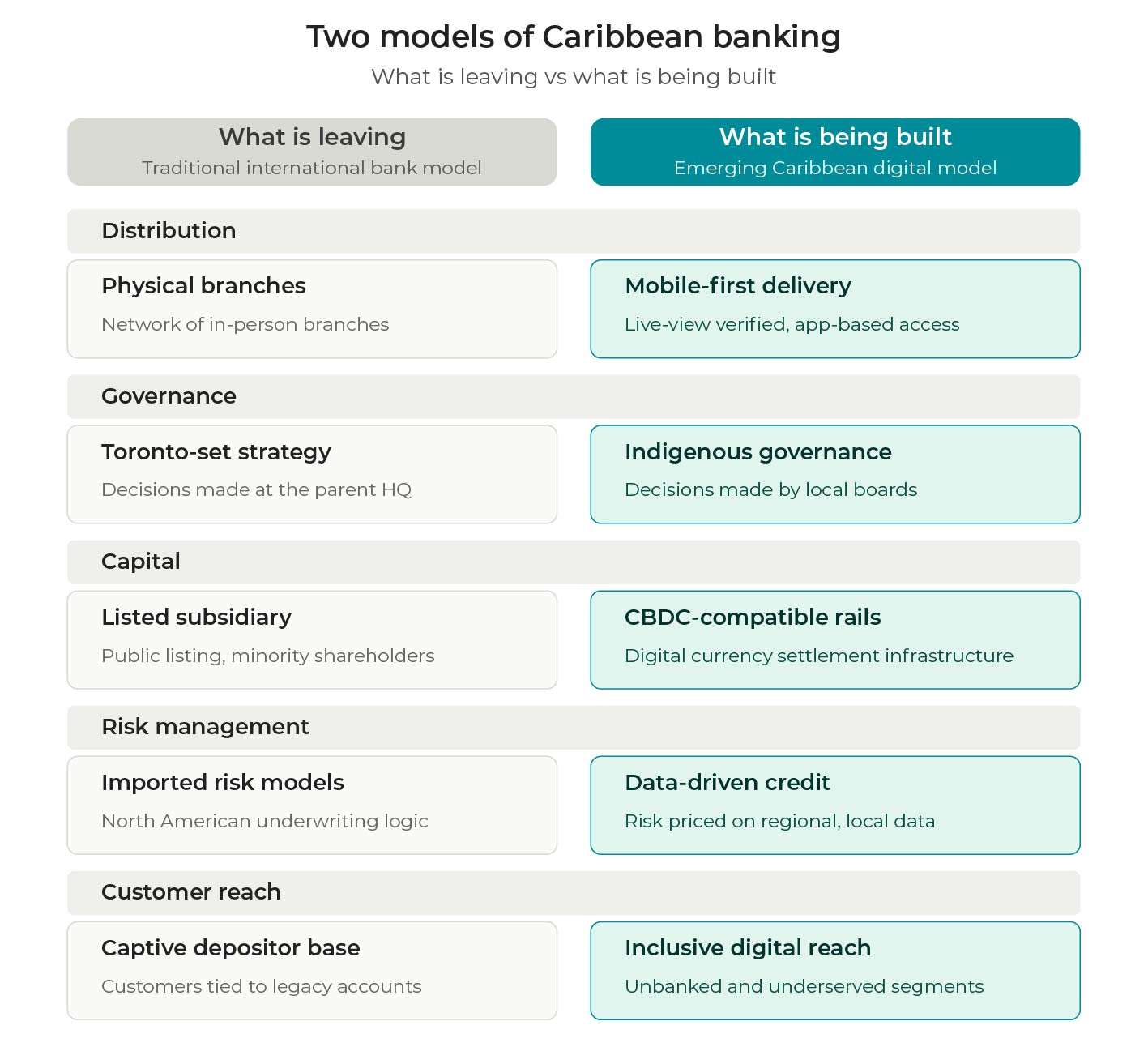
The branch era of banking, the physical presence, the listed local subsidiary, the community relationship built on a network of tellers and loan officers, is being renegotiated. Not because Caribbean customers are less valuable, but because the architecture of banking itself has changed. Understanding that shift, and preparing institutions to lead through it rather than react to it, is one of the most pressing governance challenges in the region today.
What Is Scotiabank Actually Doing, and Why Does It Matter?
The mechanics of the deal are specific. Scotiabank Caribbean Holdings Limited, which already controls 71.78% of Scotia Group Jamaica Limited, is seeking court approval under Jamaica’s Companies Act, 2004, to acquire the remaining minority shareholders at J$61.50 per share, a premium of approximately 13% over the 30-day volume-weighted average price as of 11 June 2026. Ernst and Young Services Limited, engaged by the independent board committee, concluded the consideration is fair from a financial point of view. The transaction is expected to close in the fourth quarter of 2026, after which Scotia Group Jamaica would be delisted from the Jamaica Stock Exchange.
What makes this more than a capital markets event is the trajectory it sits within. CIBC’s Caribbean banking subsidiary is undergoing a comparable restructuring within the region itself: in May 2026, Bermuda-based Butterfield Bank agreed to acquire 91.7% of CIBC Caribbean Bank Limited in a US$1.8 billion transaction, creating a combined institution with approximately US$29 billion in assets, according to Butterfield’s own regulatory filing. CIBC is not exiting the region outright. As part of the arrangement, CIBC will hold approximately 22% of the combined Butterfield entity and nominate two directors to its board, converting a controlling Caribbean banking operation into a substantial minority stake in a Bermuda-headquartered acquirer. The distinction matters: this is not a clean retreat, it is a reduction in direct operational control in favour of a smaller, governance-linked stake. Scotiabank’s transaction with Scotia Group Jamaica follows a different mechanism, a full buyout rather than a stake conversion, but both transactions point to the same underlying pattern: Canadian and Bermuda-based banking groups are restructuring how, and how directly, they hold their English-speaking Caribbean exposure. This pattern is distinct from Scotiabank’s separate decision, announced in January 2025 and completed in December 2025, to transfer its retail banking operations in Colombia, Costa Rica, and Panama to Colombia’s Banco Davivienda. That transaction involved Latin American and Central American markets outside the English-speaking Caribbean, and the bank’s own reporting in the same period showed its Caribbean operations, including Jamaica and the Bahamas, posting some of their strongest profitability in a decade. The two trends should not be conflated: Scotiabank’s Latin American divestment reflected underperformance in those specific markets, while its English-speaking Caribbean operations remained profitable even as the ownership structure of those operations is now changing.
Scotiabank itself frames the Jamaica transaction in capital terms rather than in terms of branch relevance. The bank’s own announcement describes the deal as part of a strategy to optimise capital and improve operational efficiency across its regional footprint, and Group Head Francisco Aristeguieta spoke of a “legacy of nearly 137 years in Jamaica” and an ongoing commitment to the market. That is Scotiabank’s account of its own motive, and there is no public evidence contradicting it on its own terms. InfraNova Advisory’s argument in this piece is a separate, structural one: that capital optimisation calculations of this kind have themselves shifted, because a branch network that once justified its own balance sheet cost as the price of market access no longer carries that same justification when live-view verification and digital rails deliver most of what a branch used to provide. Scotiabank may not frame its own decision in those terms. However, the region’s institutions should understand the shift in those terms regardless.
The question is not whether this is good or bad in isolation. The question is what it means for the financial ecosystems those institutions helped build, and whether the Caribbean is positioned to fill the institutional gap they leave behind.
The departure of international banks from the Caribbean is not the crisis. The crisis would be failing to build the governance infrastructure, digital capability, and institutional depth that makes locally anchored financial services viable at scale.
Why Are Banks Leaving? The Digital Shift That Changed the Calculus
International banks built their Caribbean presence on a specific economic model: physical branches, captive local depositors, and the regulatory credibility of a Canadian parent guarantee. That model produced real value for decades. It also produced real costs: branch networks, staff overhead, local listing compliance, and the responsibility of holding minority shareholders accountable to a public market.
The economics of that model are no longer as compelling as they once were, and digital banking is the primary reason. According to the European Central Bank’s Financial Stability Review published in May 2025, approximately 60 banks in the euro area were identified as digital-only by year-end 2024, and the market share of digital banks in total assets has grown from 3.1% in 2019 to 3.9% in 2024. The trend is directional: services that once required a branch, account opening, mortgage applications, international transfers, and identity verification are now delivered through mobile interfaces, with live-view validation replacing the need for physical presence.
The IMF’s 2025 Financial Access Survey, published in October 2025, documents that digital transactions across emerging and developing economies grew from 55 transactions per adult in 2017 to 251 per adult by 2024. Digital payment flows in remittances alone rose from 13% of total flows in 2019 to 46% by 2024. For the Caribbean, which receives critical remittance volumes, the Inter-American Development Bank reported that Latin America and the Caribbean received approximately US$173.7 billion in remittances in 2025, a 7.3% increase over 2024, with an increasing proportion of those flows moving through digital rather than traditional banking rails.
Cryptocurrency and stablecoin infrastructure have further disrupted the logic of intermediation. Where a cross-border transfer once required a correspondent banking chain, multiple fee deductions, and two to five business days, blockchain-based stablecoin rails now enable near-instant settlement at a fraction of the cost. The Bank for International Settlements has been piloting projects, including mBridge for multi-CBDC payments and Project Nexus for connecting instant payment systems, that signal where institutional cross-border infrastructure is heading. Caribbean central banks are already in this space: the Central Bank of the Bahamas launched the Sand Dollar in October 2020, the Eastern Caribbean Central Bank launched its DCash pilot in March 2021, and the Bank of Jamaica launched JAM-DEX, recognised as legal tender, in July 2022.
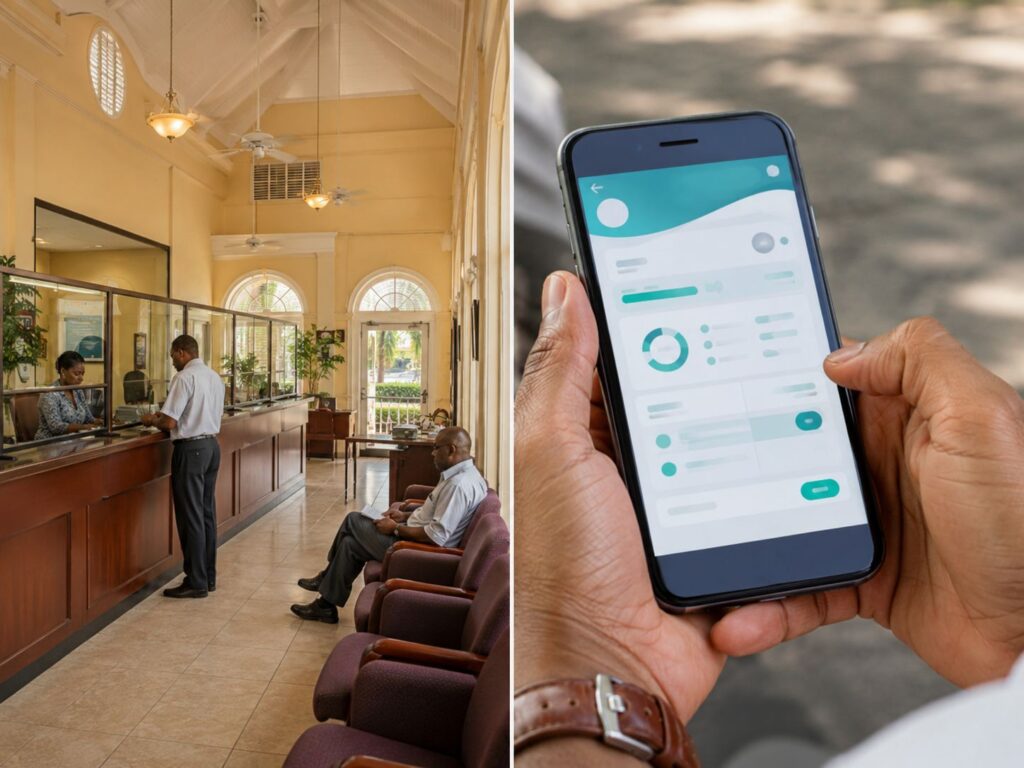
The branch, in other words, is no longer the irreplaceable distribution channel it once was. And when the branch is no longer irreplaceable, the business case for maintaining a full public listing, a local board, and a minority shareholder base in every market becomes harder to justify from Toronto.
Caribbean banking is changing faster than most institutions are planning for.
InfraNova Insights delivers governance-led analysis of digital transformation, financial technology, and institutional strategy for Caribbean professionals who need to stay ahead of the shift.
What Does the Vacuum Look Like, and Who Fills It?
When a major listed bank exits a public market, the immediate concern is investor access. The Jamaica Stock Exchange stands to lose one of its most significant anchor listings. According to Mayberry Group CEO Gary Peart, the buyout will inject roughly C$500 million into the local market in the short term, a meaningful liquidity event for Jamaican investors, while permanently removing local investor access to one of the country’s most profitable banking institutions over the longer term.
But the deeper concern is institutional: what happens to the financial services capacity that an international bank presence provided? Credit origination, mortgage underwriting, enterprise banking, trade finance, these are not functions a neobank app replaces overnight. The World Bank’s Global Findex 2025 report documents that 37% of adults in Latin America and the Caribbean now have a mobile money account, up from 22% in 2021, which is meaningful progress. But mobile money accounts and enterprise credit facilities are not the same product serving the same market. The populations most served by a Scotiabank branch network are not the same populations already transacting exclusively on digital rails.
The risk, then, is a two-speed financial system. One tier consists of digitally enabled customers, urban, educated, connected, migrating seamlessly to neobanks, crypto wallets, and digital payment platforms. The other tier consists of everyone else: rural communities, older demographics, unbanked small businesses, people for whom the branch closing is not an inconvenience but a severance from the formal financial system.
Caribbean regulators have a governance obligation here that extends beyond approving or rejecting individual transactions. The question of how financial services reach the full population, not just the digitally ready portion, requires active digital infrastructure policy, not passive market observation.
Is This a Crisis or an Opportunity for Caribbean Institutions?
The honest answer is that it is both, and which one materialises depends entirely on what Caribbean institutions do next.
The withdrawal of international banks from a market has historically created space for domestic institutions to scale. Credit unions, indigenous commercial banks, and development finance institutions across the Caribbean are, in many cases, better positioned than they have been in decades to absorb market share. But absorbing market share in a digital banking environment requires something more than goodwill and community relationships. It requires enterprise-grade data infrastructure, cybersecurity architecture, regulatory technology capability, and the governance frameworks to operate these systems responsibly at scale.
This is not a technology procurement conversation. It is a governance and strategy conversation. The institutions that will win the next decade of Caribbean financial services are those that can combine the trust of long community relationships with the data intelligence and operational discipline of a modern digital bank. That combination does not emerge from installing a mobile app. It emerges from a deliberate transformation of operating models, data governance standards, and risk management frameworks.
The COCOA AI Framework, InfraNova Advisory’s five-stage methodology for responsible AI adoption- Create, Organise, Customise, Optimise, Automate – offers a structured pathway for exactly this kind of transformation. The Create and Organise stages address the data foundations and system integration that financial institutions need before any automation or AI layer can deliver reliable results. The Customise and Optimise stages translate those foundations into decision intelligence tools, credit analytics, fraud detection, and customer behaviour modelling specific to Caribbean market conditions, rather than being imported wholesale from a North American context. The Automate stage, applied responsibly, reduces operational costs and improves service delivery without removing the human oversight that regulated financial institutions require.
For Caribbean financial institutions thinking about where to begin, the answer is almost always the same: governance first. Understanding what data you hold, where it lives, how it is protected, and whether it meets the standards required by both local regulators and international frameworks such as ISO/IEC 27001 for information security management, is the prerequisite for everything that follows. Digital transformation without that foundation does not produce a digital bank. It produces a digital liability.
What Should Caribbean Policymakers and Regulators Do Now?
The Scotiabank Jamaica transaction requires dual approval: a majority by number and at least 75% by value of minority shares voted, followed by sanction from the Supreme Court of Jamaica. The minority shareholders, pension funds, unit trusts, and ordinary Jamaicans holding that 28.22% stake have real power to push back if they believe the J$61.50 offer does not reflect the bank’s trajectory. Scotia Group Jamaica reported a consolidated loan book of J$378.32 billion for the six months ended 30 April 2026, with J$127 billion in residential mortgages and profit before tax up 9% to J$15.41 billion, according to the company’s own half-year results. Gary Peart, CEO of the Mayberry Group, has stated publicly that minority shareholders accepting the buyout will permanently lose access to one of Jamaica’s most profitable companies, noting that in the long term they will be losing out on profits from what he described as probably one of the top five profit-making entities in Jamaica.
But beyond the transaction itself, regulators and stock exchanges have a broader obligation to speak publicly, and urgently, about what a pattern of international bank consolidation and withdrawal means for the architecture of Caribbean capital markets. Individual transactions get approved or rejected in isolation. Patterns require policy responses.
Three areas warrant immediate attention. First, digital financial services regulation must keep pace with adoption. The IMF Working Paper on Cross-Border Payments Integration in Latin America and the Caribbean, published in 2024, identifies legal and regulatory frameworks as a priority theme for the region, noting that payment system interoperability and extension require harmonised standards that most Caribbean jurisdictions have yet to implement.
Second, financial inclusion in a digital banking era is not automatic. Mobile money adoption in the Caribbean is growing, but access to digital infrastructure, smartphones, reliable internet connectivity, digital identity systems, is uneven across the region. Policy investment in that infrastructure is a precondition for meaningful inclusion, not a luxury.
Third, the governance of AI and data in financial services requires regulatory frameworks that most Caribbean jurisdictions are only beginning to develop. As institutions adopt AI-powered credit scoring, fraud detection, and customer service automation, the risk of algorithmic bias, data misuse, and accountability gaps grows proportionally. Standards such as ISO/IEC 42001:2023 for AI management systems provide a starting framework, but regulators need to build the capacity to oversee these systems, not simply require compliance with them on paper.
What the Next Five Years of Caribbean Banking Could Look Like
The trajectory is not entirely pessimistic. The same digital infrastructure that is enabling international banks to reduce their physical footprint is also enabling new entrants to reach customers that traditional banks never served efficiently. Caribbean fintech ecosystems are growing. The Eastern Caribbean Central Bank’s DCash pilot, launched in March 2021 and discontinued in January 2024 to allow a transition to a planned next version, generated real-world data on how a regional CBDC can facilitate digital payments in an economy where cash has historically dominated. Jamaica’s JAM-DEX and the Bahamas’ Sand Dollar represent genuine first-mover positions in a global experiment that most central banks are still only observing.
The institutions that will define Caribbean banking in 2031 are probably already operating today, though not necessarily at the scale that will make them visible until the international incumbents have finished their retreat. They are credit unions with the member trust to absorb mortgage portfolios. They are indigenous commercial banks with the local intelligence to price Caribbean risk more accurately than a Toronto model ever could. They are fintech ventures building payment rails that serve the diaspora remittance corridor at a fraction of the cost of traditional systems.
What those institutions need, and what the Caribbean’s policy environment should be urgently building capacity to provide, is the governance architecture, the data strategy, and the risk management discipline to scale without compromising the trust that their communities have placed in them.
The branch is leaving the building. What matters now is whether Caribbean institutions are ready to build something better in its place.
Frequently Asked Questions
Why are international banks reducing their presence in the Caribbean?
The economics of physical branch banking have shifted. Digital banking, live-view identity verification, and instant payment infrastructure have removed much of the cost justification for large branch networks and local listings, a structural change documented in the European Central Bank’s 2025 Financial Stability Review and the IMF’s 2025 Financial Access Survey. InfraNova Advisory’s position is that this is a long-term structural adjustment, not a short-term retreat, and that Caribbean institutions should plan for it accordingly.
What happens to Caribbean financial services when international banks step back?
The capacity gap falls to local institutions: credit unions, indigenous banks, and regional fintechs. InfraNova Advisory’s position is that these institutions can absorb that demand only if they first build enterprise-grade data governance, cybersecurity architecture, and risk management discipline, because community trust without digital and governance capability is not enough to operate at scale in a digital banking environment.
How should Caribbean institutions respond to the shift in regional banking?
Governance first. InfraNova Advisory’s position is that the institutions positioned to lead are those that treat this as a governance and strategy challenge rather than a technology purchase, building data foundations and risk frameworks before automation, in line with recognised standards such as ISO/IEC 27001 and ISO/IEC 42001:2023.
? Recommended Reading
The End of Banking: Money, Credit, and the Digital Revolution by Jonathan McMillan (2014, Zero/One Economics GbR) remains one of the clearest frameworks for understanding why the traditional banking model, built on branch networks and balance sheet leverage, is structurally incompatible with the digital economy. McMillan argues that the regulatory frameworks governing banks were designed for a world of physical financial intermediation, and that the digital shift not only changes the delivery of banking but also challenges the foundational logic of how banks create and distribute credit. For Caribbean executives and policymakers watching international banks rationalise their regional presence, this book provides the conceptual vocabulary to understand not just what is happening but also why the trend is structural rather than cyclical.
InfraNova Advisory
Your institution needs a digital banking strategy before the gap becomes a crisis.
InfraNova Advisory works with Caribbean financial institutions, regulators, and boards to design governance-led digital transformation strategies that build institutional resilience without compromising community trust. As international banks rationalise their regional footprints, the institutions positioned to lead are those investing in data governance, risk architecture, and decision intelligence now, not after the market has already shifted.
References
- Bank of N.T. Butterfield & Son Limited. (2026, May 28). Butterfield announces agreement to acquire control of CIBC Caribbean in $1.8 billion transaction [Press release]. Business Wire. https://www.businesswire.com/news/home/20260528619464/en/Butterfield-Announces-Agreement-to-Acquire-Control-of-CIBC-Caribbean-in-$1.8-Billion-Transaction
- Caribbean360 Editorial. (2026, June 18). Is Scotiabank quietly untethering itself from Jamaica? Caribbean360. https://caribbean360.com/is-scotiabank-quietly-untethering-itself-from-jamaica
- Drakopoulos, D., Mu, Y., Vasilyev, D., & Villafuerte, M. (2024). Cross-border payments integration in Latin America and the Caribbean (IMF Working Paper No. 24/119). International Monetary Fund. https://www.imf.org/en/publications/wp/issues/2024/06/14/cross-border-payments-integration-in-latin-america-and-the-caribbean-550522
- European Central Bank. (2025, May). Digital banking: How new bank business models are disrupting traditional banks. Financial Stability Review. https://www.ecb.europa.eu/press/financial-stability-publications/fsr/focus/2025/html/ecb.fsrbox202505_04~17b39a3c1a.en.html
- Harris, J., Maldonado, R., & Cortés Sánchez, P. (2026). Remittances to Latin America and the Caribbean ease after 2025 surge. Inter-American Development Bank. https://www.iadb.org/en/blog/migration/remittances-latin-america-and-caribbean-ease-after-2025-surge
- International Monetary Fund. (2024). Central bank digital currency adoption: Inclusion strategies for emerging market and developing economies (Fintech Note No. 2024/005). https://www.imf.org/en/Publications/fintech-notes/Issues/2024/09/26/Central-Bank-Digital-Currency-Adoption
- International Monetary Fund. (2025, October). IMF releases the 2025 Financial Access Survey results. IMF Press Release No. 25/351. https://www.imf.org/en/news/articles/2025/10/29/pr-25351-imf-releases-the-2025-financial-access-survey-results
- Jamaica Gleaner. (2026, June 12). Scotia Group moves to delist from JSE to go private, shareholders to vote. https://jamaica-gleaner.com/article/business/20260612/scotia-group-moves-delist-jse-go-private-shareholders-vote
- Jamaica Gleaner. (2026, June 14). Mayberry Group CEO: Scotiabank buyout will inject C$500m into market, but at a cost. https://jamaica-gleaner.com/article/business/20260614/mayberry-group-ceo-scotiabank-buyout-will-inject-c500m-market-cost
- Jamaica Observer. (2026, June 12). Scotiabank moves to take Scotia Group Jamaica private. https://www.jamaicaobserver.com/2026/06/12/scotiabank-moves-take-scotia-group-jamaica-private/
- Jamaica Observer. (2026, June 17). Explainer: What does the Scotiabank $54-b acquisition of Scotia Group Jamaica mean for you? https://www.jamaicaobserver.com/2026/06/17/explainer-scotiabank-54-b-acquisition-scotia-group-jamaica-mean/
- Jamaica Observer. (2026, June 17). Scotia Group maintains growth with $378-billion loan book. https://www.jamaicaobserver.com/2026/06/17/scotia-group-maintains-growth-378-billion-loan-book/
- Jamaica Observer. (2025, January 17). Scotiabank to exit Colombia, Costa Rica, and Panama operations in strategic shift. https://www.jamaicaobserver.com/2025/01/17/scotiabank-exit-colombia-costa-rica-panama-operations-strategic-shift/
- Scotiabank Jamaica. (2026, June 12). Scotiabank reaffirms commitment to Jamaica as it moves towards privatising SGJL [Press release]. https://jm.scotiabank.com/about-scotiabank/media-centre/news-releases/scotiabank-reaffirms-commitment-to-jamaica-as-it-moves-towards-privatising-sgjl.html
- Scotiabank. (2026, June 12). Scotiabank announces plans to fully acquire Scotia Group Jamaica Limited [Press release]. Newswire.ca. https://www.newswire.ca/news-releases/scotiabank-announces-plans-to-fully-acquire-scotia-group-jamaica-limited-811213061.html
- World Bank. (2025). The Global Findex Database 2025: Connectivity and financial inclusion in the digital economy. World Bank Group. https://www.worldbank.org/en/publication/globalfindex