
The conversation around artificial intelligence in boardrooms has shifted. It’s no longer about whether AI will transform operations, it’s about how to adopt it without exposing the organisation to unacceptable risk. For Caribbean enterprises and public sector institutions, this question carries added weight. Limited technical capacity, fragmented regulatory environments and heightened sensitivity around citizen and customer data mean that getting AI governance wrong can undermine years of digital progress.
The good news? A clear, structured approach to AI risk and data governance exists. It doesn’t require massive budgets or Silicon Valley expertise. What it does require is discipline, leadership alignment and a commitment to treating data as a strategic, not operational, concern.
Why Data Privacy and AI Risk Are Inseparable
AI systems are data-intensive by design. They rely on historical data to learn, real-time data to execute and feedback data to improve. But the moment AI touches personally identifiable information (PII), health records, financial transactions or citizen data, privacy and security obligations activate. In jurisdictions governed by GDPR, POPIA or emerging Caribbean data protection laws, non-compliance can result in significant fines, reputational damage and loss of public trust.
According to the International Data Corporation, global spending on AI governance and compliance tools is projected to exceed USD 1.8 billion by 2026, reflecting a recognition that AI without governance is a liability, not an innovation. Caribbean organisations may not be investing at that scale, but the principle holds: responsible AI begins with data stewardship.
The Risk Landscape: What Keeps Executives Awake
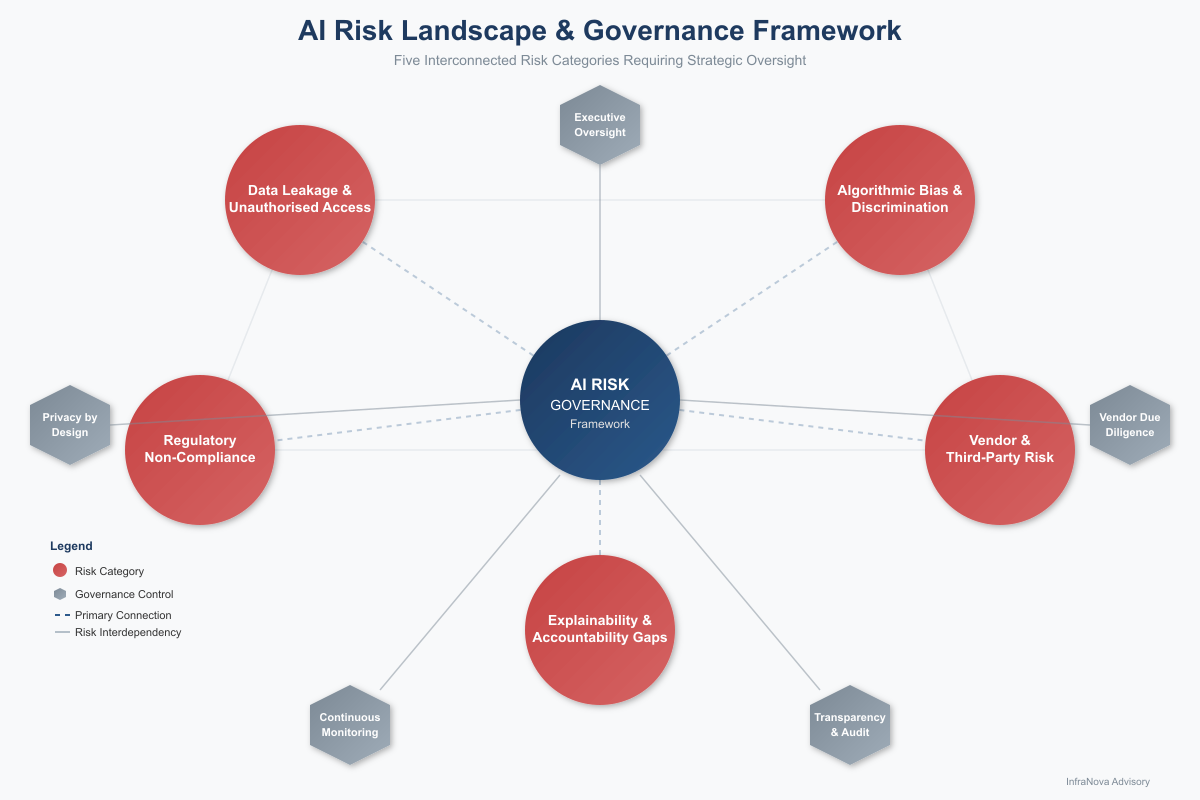
AI introduces several categories of risk that intersect with data privacy. Understanding these is the first step toward managing them.

Data leakage and unauthorised access occur when AI models are trained on sensitive datasets without proper anonymisation or access controls. A poorly configured cloud-based AI tool can inadvertently expose confidential information to third parties or external vendors.
Algorithmic bias and discriminatory outcomes emerge when training data reflects historical inequalities. In public sector contexts—such as social services allocation or law enforcement—biased AI can perpetuate injustice while appearing objective.
Regulatory non-compliance arises when AI systems process personal data in ways that violate data protection statutes. Many organisations assume that because a tool is commercially available, it is compliant. That assumption is dangerous.
Vendor and third-party risk is often underestimated. If your organisation uses AI-as-a-Service platforms, you are entrusting sensitive data to external parties whose security posture, data residency practices and subprocessor arrangements you may not fully understand.
Finally, explainability and accountability gaps create legal and operational challenges. When an AI system makes a decision that affects citizens or customers, can you explain why? Can you audit it? If not, you have a governance problem.
A Practical Framework for AI Risk and Data Governance
Managing AI risk is not a one-off project. InfraNova’s COCOA AI Framework operationalises exactly this structuring AI adoption across five progressive stages, from data foundations through to responsible automation, so governance is built in from day one rather than retrofitted at the end and treated like a checklist item. It is a continuous governance discipline that must be embedded into enterprise architecture, procurement processes and executive oversight. The following framework reflects best practices observed across regulated industries and public sector transformation programmes.
Establish a Cross-Functional AI Governance Committee
AI governance cannot be delegated solely to IT. It requires input from legal, compliance, risk, privacy, operations and executive leadership. The committee’s mandate should include approving AI use cases, reviewing vendor contracts, monitoring ongoing performance and ensuring alignment with organisational values and regulatory obligations.
This committee must have executive sponsorship. Without it, governance becomes a checklist exercise rather than a decision-making mechanism.
Conduct a Data Inventory and Classification Exercise
You cannot govern what you do not know. Begin by mapping all datasets that could be used in AI systems. Classify them by sensitivity: public, internal, confidential, restricted. Identify which datasets contain PII, health information, financial records or other protected categories.
This inventory forms the foundation for access controls, encryption requirements and data minimisation practices. It also allows you to assess whether your organisation even has the legal and ethical right to use certain data for AI purposes.
Implement Privacy by Design and Data Minimisation Principles
Privacy by Design, a concept formalised by regulators globally, requires that data protection be embedded into system architecture from the outset—not retrofitted after deployment. For AI systems, this means ensuring that models are trained on the minimum data necessary, that data is anonymised or pseudonymised where possible and that retention periods are enforced.
Data minimisation is particularly critical in Caribbean contexts, where many organisations still maintain legacy datasets collected under outdated consent frameworks. AI should not become a justification for hoarding data indefinitely.
Adopt a Risk-Based Approach to AI Deployment
Not all AI use cases carry the same risk. A chatbot answering frequently asked questions presents far less risk than an AI system determining eligibility for social benefits or flagging individuals for investigation. A risk-based approach allows organisations to allocate governance resources proportionally.
High-risk AI applications—those involving sensitive data, automated decision-making or significant consequences for individuals—should undergo rigorous impact assessments, including Data Protection Impact Assessments (DPIAs) where required by law. Lower-risk applications may proceed with lighter governance, but never without oversight.
Vet Vendors and Enforce Contractual Safeguards
If you are procuring AI tools or platforms, vendor due diligence is non-negotiable. Ask where data will be stored, who has access to it, whether subprocessors are involved and what happens to your data if the contract ends. Request evidence of security certifications such as ISO 27001 or SOC 2.
Contracts must include explicit data processing terms, confidentiality obligations, audit rights and breach notification requirements. In jurisdictions with data protection laws, these terms are often legally mandated, but even where they are not, they represent basic risk hygiene.
Build Transparency and Explainability into AI Systems
Transparency is both a technical and governance challenge. Technically, it means selecting AI models that can be interpreted and audited. Governance-wise, it means documenting how decisions are made, maintaining logs and ensuring that individuals affected by AI decisions have recourse to human review.
The European Union’s AI Act, now in force, establishes transparency obligations for high-risk AI systems. While Caribbean jurisdictions have not yet adopted equivalent legislation, organisations operating regionally or internationally should anticipate similar requirements. Proactive transparency builds trust and reduces litigation risk.
Monitor, Audit and Iterate Continuously
AI systems are not static. They learn, adapt and drift over time. Performance that was acceptable at launch may degrade. Bias may emerge as input data changes. Continuous monitoring is essential.
Establish key performance indicators (KPIs) for AI systems that include accuracy, fairness, explainability and compliance. Conduct periodic audits—both internal and, where appropriate, external to validate that systems operate as intended and within regulatory boundaries. Treat AI governance as a living discipline, not a launch-day formality.
Stay ahead of AI governance developments in the Caribbean.
Subscribe to InfraNova Insights — practical perspectives on AI risk, data governance, and responsible digital transformation, written for executives.
The Role of Leadership in AI Governance
Technology teams can build secure systems, but they cannot mandate organisational culture. That responsibility rests with executive leadership. Boards and C-suites must signal that data privacy and AI risk are strategic priorities, not IT problems.
This means allocating budget, appointing accountable owners and refusing to approve AI initiatives that lack robust governance foundations. It also means asking hard questions: Do we have the right to use this data? What happens if this system fails? Are we prepared to explain this decision publicly?
In Caribbean contexts, where trust in institutions is often fragile, these questions carry even greater weight. The trust dimension is explored in depth in Insurance Was Never the Problem. It Was the Packaging. — a sector-specific examination of how AI governance failures play out when deployed into environments where public confidence is already strained.
AI adopted responsibly can enhance service delivery and citizen engagement. AI adopted recklessly can erode confidence and invite regulatory intervention.
Moving Forward: Governance as Competitive Advantage
Organisations often view governance as a constraint. In reality, governance is what makes innovation sustainable. A well-governed AI programme reduces legal risk, accelerates stakeholder buy-in, protects brand reputation and positions the organisation as a responsible steward of data.
For Caribbean organisations navigating resource constraints and evolving regulatory landscapes, the best approach to managing AI risk and data privacy is straightforward: start with governance, not technology. Build the frameworks, establish the oversight and ensure leadership alignment before deploying a single model.
AI will reshape how organisations operate. But only those who govern it wisely will reap the benefits without bearing the costs.
References
Information Commissioner’s Office. (2023). Guidance on AI and data protection. ICO.org.uk. https://ico.org.uk/for-organisations/uk-gdpr-guidance-and-resources/artificial-intelligence/guidance-on-ai-and-data-protection/
World Economic Forum. (2023). AI governance and risk management: A framework for responsible innovation. WEF Centre for the Fourth Industrial Revolution.
European Union. (2024). Regulation (EU) 2024/1689 of the European Parliament and of the Council (Artificial Intelligence Act). Official Journal of the European Union.
Organisation for Economic Co-operation and Development. (2023). OECD AI Principles overview. OECD Digital Economy Papers. https://www.oecd.org/digital/artificial-intelligence/
International Data Corporation. (2023). Worldwide spending on AI governance and compliance solutions forecast, 2023–2026. IDC Research.