Trinidad’s AI Textbooks Are a Good Start. Here Is the Guardrail That Is Missing.
I will say this plainly at the outset: I endorse this move. As a technologist who has spent 25 years building national ICT systems, and as a parent raising a five-year-old in a world of screens, I want Trinidad and Tobago’s children to grow up fluent in the tools that will define their working lives. The Ministry of Education’s AI-assisted digital textbooks are an ambitious, regionally significant step, and the instinct behind them is right. But endorsing a destination is not the same as endorsing every route to it. The question that matters now is not whether AI belongs in Caribbean classrooms, It is who stands between the child and the machine.
What Has Trinidad and Tobago Actually Launched?
The Ministry of Education has launched the first two AI-assisted digital textbooks for Form One students, covering Mathematics and Language Arts, delivered on government-issued laptops and designed to work offline.
Education Minister Dr Michael Dowlath confirmed at the April launch that the textbooks are aligned with the national curriculum from Form One through to Form Five and include an AI avatar that students can consult for their academic work during and after school hours. Four further subjects, Science, Information Technology, Social Studies and Spanish, are scheduled to follow by August, ahead of the new academic year. The Minister has stated that the six digital textbooks will save parents of Form One and Form Two students between TT$1,000 and TT$1,500 at the start of the next academic year, and that within three years the Ministry expects to develop AI textbooks for all levels of secondary school, and eventually primary schools.
Two things are worth applauding without reservation. The offline capability directly addresses the connectivity gaps that undermine so many regional public-sector digital transformation programmes, and, secondly, the affordability framing recognises that textbook costs are a genuine burden on Caribbean households. This is not a vanity project. It is a serious initiative with a real problem behind it.
What Does Sweden’s Classroom Reversal Teach Us?
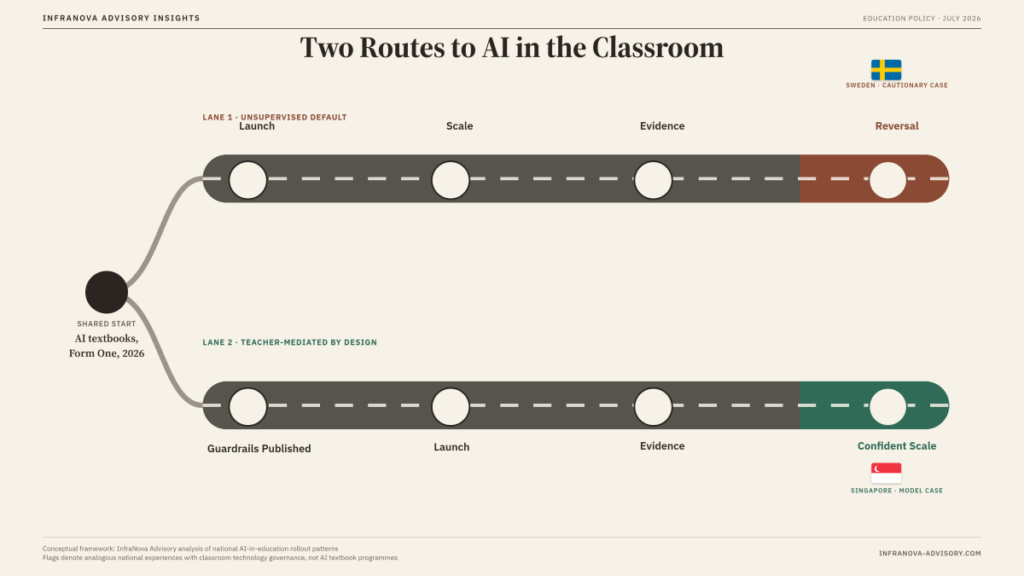
Sweden, once the global benchmark for screen-first education, has spent the past three years funding a return to printed textbooks after national reading outcomes declined in the 2021 Progress in International Reading Literacy Study (PIRLS). We examined that reversal in detail in an earlier InfraNova Advisory Insights piece, and the lesson bears repeating here because it is so often misread. Sweden did not conclude that digital tools are harmful. The Swedish Ministry of Education’s stated position is that digitalisation remains fundamentally important, but that digital tools in schools must be deployed with care, at the right age, and on the basis of evidence.
The failure Sweden corrected was not a technology failure. It was a governance failure: digital became the unexamined default, physical materials quietly fell away, and the evidence arrived only after a generation of learners had already gone through the system. That is the precise scenario Trinidad and Tobago can still avoid, because it is early enough to design the guardrails rather than retrofit them.
One implication deserves to be stated directly. AI textbooks should supplement physical textbooks, never replace them. Nothing in the Ministry’s public statements says printed books are being withdrawn, and Minister Dowlath has himself acknowledged that hard-copy textbooks have their advantages. But an assurance in a launch speech is not a policy. A written commitment that physical learning materials remain part of the core provision would cost nothing and would signal that Trinidad and Tobago has studied the Swedish experience rather than repeated its opening move.
Follow the governance questions behind the region’s biggest technology decisions.
InfraNova Insights examines Caribbean digital transformation through the lens of risk, governance and ownership. Get every analysis as it publishes.
Is Form One Too Young for Unsupervised AI?
UNESCO’s Guidance for Generative AI in Education and Research, still the only global standard of its kind, recommends a minimum age of 13 for independent use of generative AI tools, while most Form One students in Trinidad and Tobago are 11 or 12 years old.
That guidance, published in 2023, also notes that the European Union’s GDPR sets the equivalent consent threshold at 16, and calls on governments to mandate data protection for learners and to train teachers before generative AI reaches classrooms. The word doing the work in UNESCO’s recommendation is independent. The concern is not a child encountering AI. It is a child alone with AI: no teacher framing the interaction, no adult observing the pattern of use, no institutional check on what the system tells an eleven-year-old about the world.
The Ministry’s own description of the programme, a child at home opening a laptop and asking the avatar about a mathematics problem, is precisely the independent use case UNESCO’s age guidance addresses. That does not make the feature wrong. It makes the supervision policy around it the most important unpublished document in this rollout.
How Do Global Education Leaders Deploy AI in Classrooms?
Singapore, widely regarded as the global benchmark for education technology governance, deploys its national AI Learning Assistant as a teacher-activated tool with built-in limits on student interactions and mandatory teacher supervision for primary school pupils.
The detail matters. According to Singapore’s Ministry of Education, the Learning Assistant (LEA) within the national Student Learning Space is available only from Primary 4 upwards, must be used under teacher supervision through Primary 6, caps the number of interactions a student can have with the chatbot, and is deliberately designed to ask guiding questions rather than supply answers, specifically to minimise what the Ministry calls cognitive offloading and dependence on AI. Students also complete an AI literacy module before using the tools.
The wider pattern among leading systems is consistent. A 2026 global survey of national AI-in-education strategies published by Getting Smart found that South Korea scales its AI tools through designated pilot schools and regional teacher-training hubs before national rollout, and that systems such as Estonia and Singapore emphasise enablement, meaning tools paired with funded teacher training, over deployment alone. The through-line is unmistakable: in every serious system, the AI is subordinate to the teacher, not adjacent to the child.
The Global Direction of Travel Is Restriction, Not Expansion
While Trinidad and Tobago expands children’s screen-based access, the jurisdictions it often benchmarks against are moving in the opposite direction on unsupervised device use. In the United States, 35 states and Washington, D.C. have now enacted laws or policies restricting student mobile phone use in schools. Every major Canadian province has introduced classroom or full-day phone restrictions since 2024, with Quebec extending its ban to the entire school day, including breaks, from September 2025. In Australia, mobile phones are banned in all government schools, and South Australia’s Department for Education reported an 82 per cent decline in phone-related incidents in early 2026 compared with the period before its ban. Peer-reviewed research on the South Australian policy notes that similar bans now exist in roughly one in four countries worldwide, a figure drawn from UNESCO’s 2023 global monitoring work.
None of this is an argument against the AI textbook programme. A curriculum-aligned learning tool on a managed device is not a social media feed on a personal phone, and conflating the two would be lazy analysis. But the global trend toward restrictions tells Caribbean policymakers something they cannot ignore: the world’s best-resourced education systems, after a decade of evidence, have concluded that children’s screen access requires active governance, not good intentions. A Small Island Developing State’s digital strategy has less fiscal room for course correction than Sweden had. Getting the governance right the first time is not a caution. It is the economy.
What Does the Evidence Say About Screens and Children’s Behaviour?
The American Academy of Paediatrics’ updated 2026 guidance moves away from rigid hourly limits towards an approach built on content quality, context, and adult involvement, while holding firm that screens should never displace sleep, physical activity, play, or family time.
The behavioural evidence behind the caution is substantial. The Government of South Australia, announcing its 2026 policy results, cited a decade-long Murdoch Children’s Research Institute study of around 1,200 students which found that young people spending two or more hours daily on social media face a greater risk of depression, anxiety and poor wellbeing, with the strongest effects among girls aged 12 to 13. That is the exact age band now receiving AI avatars in Trinidad and Tobago. Again, an educational avatar is not social media. But the age sensitivity of the evidence is the reason usage limits, monitoring and adult mediation are standard practice in every comparable rollout, and the reason their absence from this one deserves public attention.
Our Recommendation: Teacher-Mediated Engagement by Design
Here is where I return to the personal register, because this is where my professional judgement and my instincts as a parent converge. I have spent a career arguing for technology adoption in Caribbean institutions. I hold no brief for nostalgia. And it is precisely because I believe in this programme’s potential that I believe its AI engagement model should be teacher-mediated by design, not by accident and consistent.
InfraNova Advisory’s position is that student interaction with the AI avatar should be teacher-initiated and teacher-supervised within the school setting as the default operating model, with independent at-home use enabled only once the Ministry has published its supervision policy, data protection framework, usage limits and evaluation plan. Where home use continues in the interim, it should be subject to structured parental oversight, and the platform should give parents visibility into their child’s interaction history. This is not a restriction on the technology. It is the operating model that Singapore, the most successful education technology governance regime in the world, chose deliberately. Frameworks now exist to formalise exactly this kind of discipline: ISO/IEC 42001, the international standard for AI management systems, and the NIST AI Risk Management Framework both give ministries a ready-made structure for governing AI systems that interact with minors. This is the same governance-first sequencing embedded in our COCOA AI Framework: the Create and Organise stages, where data governance and institutional standards are established, and come before Automate for a reason.

An AI tool for children is not made safe by what it can do. It is made safe by who stands between the child and the tool. In education, that person is, and must remain, the teacher.
What Should the Ministry Publish Next?
Four documents would move this programme from promising to exemplary, and none of them requires new technology. First, a supervision and age policy stating who may use the AI avatar, in what settings, and under whose oversight, benchmarked against UNESCO’s age guidance. Second, a data protection statement covering what is collected from a child’s interactions with the avatar, where it is stored, who can access it, and how long it is retained. Third, published usage parameters: interaction limits, monitoring arrangements, and the escalation path when the system produces an incorrect or inappropriate response. Fourth, an independent evaluation framework with baseline measurement before the three-year expansion proceeds, so that Trinidad and Tobago builds its scaling decision on its own evidence rather than on launch-day optimism.
A government that publishes those four documents does not slow down its programme. It arms it against parental doubt, against opposition politics, and against the quiet drift that turned Sweden’s digital confidence into a costly reversal.
The Opportunity Is Still Fully Intact
Trinidad and Tobago has done something few governments in this hemisphere have attempted: it has put a curriculum-aligned AI learning tool into the hands of an entire national cohort, with offline capability and a genuine affordability dividend for families. That achievement stands. What the programme needs now is the governance layer that turns a bold launch into a durable institution: teacher mediation at the centre, published rules around the edges, and evidence gathered before scale. The countries that lead in education technology are not the ones that moved first. They are the ones whose guardrails were strong enough that they never had to move backwards. Trinidad and Tobago can still be one of them, and the region will be watching.
Transparency note: This article was researched and drafted with AI assistance under InfraNova Advisory’s editorial governance process. Every factual claim is verified against primary sources before publication, and the analysis, positions and recommendations are the author’s own. We advise organisations on responsible AI adoption, and we hold our own publishing to the same standard: disclosed, governed and human-accountable.
InfraNova Advisory
Deploying AI in a public institution? Design the guardrails before the headlines.
InfraNova Advisory helps Caribbean governments and institutions build the governance layer that makes AI adoption safe, defensible and durable: supervision models, data protection frameworks, ISO/IEC 42001 alignment and evaluation design. If your organisation is putting AI in front of citizens, students or customers, the guardrail conversation should happen now, not after the first incident.