
Digital transformation is often framed through technology cloud, AI, automation, ERP modernisation. Yet across the Caribbean and around the world, the organisations achieving sustainable change are the ones that understand a quieter truth: transformation is ultimately human work.
Across government Ministries, state enterprises, and private-sector firms, leaders regularly face the same pattern. The technology works. The strategy checks out. But culture, capability, and confidence determine whether transformation delivers value, stalls, or quietly slips back into the old way of working. In our region—where teams are tight-knit, customers expect warmth, and organisations are built on relationships—the human dimension becomes even more decisive.
Technology Doesn’t Transform Organisations, People Do
Industry research continues to point in the same direction. McKinsey notes that 70% of digital transformations fail largely due to people-related factors, not technology misalignment (McKinsey, 2023). Harvard Business Review similarly reinforces that employee engagement, leadership clarity, and organisational trust shape outcomes (HBR, 2022).
For Caribbean organisations, these findings are familiar. Whether it’s implementing an Enterprise GIS solution, re-architecting a national revenue system, automating back-office operations, or deploying AI-enabled services, the turning point is always adoption. Staff must accept new processes; leaders must model new behaviours; customers must trust the new experience.
Even the most elegant architecture or world-class platform underdelivers if the organisational environment is not ready to absorb it. Transformation requires readiness, transparency, and shared ownership.
Culture: The Operating System Behind the Operating Model
Culture is how people think, behave, collaborate, and respond to change is the true operating system of any organisation. In the Caribbean, this carries additional complexity:
- Many institutions operate with legacy processes and deeply embedded habits
- Change is often perceived as a threat rather than an opportunity
- Cross-agency collaboration is hindered by siloed structures
- Leadership behaviour strongly influences digital openness
Organisations that want a structured methodology for building this readiness from data foundations through to responsible automation can explore InfraNova’s COCOA AI Framework, designed specifically for Caribbean public and private sector contexts.
A future-ready culture requires three key shifts:
1. From one-off projects to continuous capability
Teams must see digital tools as enablers of everyday performance, not disruptive events.
2. From compliance to data-driven decision making
Staff need confidence in data to ensure ts reliability and purpose especially where data maturity varies.
3. From hierarchical knowledge to shared learning
High-performing institutions democratise understanding. They teach why, not only how.
Change Management as a Strategic Capability
Change management is no longer a soft skill, it is a strategic pillar. According to Prosci’s global benchmark, projects with excellent change management are six times more likely to meet objectives.
Effective change management rests on five pillars:
1. Vision Alignment
People need clarity about what is changing, why it matters, and how it affects their role.
2. Leadership-Grade Communication
Authentic, consistent, and timely communication drives trust and reduces resistance.
3. Capacity Building & Training
Training should build digital confidence—not just mechanical system use.
4. Incentives & Reinforcement
Recognition, performance frameworks, and leader modelling accelerate behavioural adoption.
5. Feedback Loops
Digital transformation must include mechanisms for listening: surveys, retrospectives, town halls, dashboards, and service analytics.
Caribbean transformation thinking, in your inbox.
Subscribe to InfraNova Insights for practical perspectives on digital transformation, change leadership, and AI adoption across the Caribbean.
Digital Transformation is Emotional Work
Every transformation touches identity. Employees fear redundancy; leaders fear exposure; customers fear losing the warmth of Caribbean service.
Addressing this emotional landscape is not optional, it is structural. High-performing organisations cultivate psychological safety where staff feel supported, included, and confident throughout the journey.
AI and Automation: Amplifiers of Human Potential
AI, machine learning, and automation often trigger anxiety. Understanding how to deploy AI responsibly with the right governance structures in place is explored in depth in Managing AI Risk and Data Privacy: A Governance-First Approach for Caribbean Organisations. The organisations that thrive are those that position AI as an enabler rather than a replacement.
Examples already emerging in the Caribbean include:
- AI-assisted triaging in revenue administration
- automated workflow routing in procurement and finance
- predictive analytics for disaster management and national security
- digital assistants improving call-centre throughput
- chatbots expanding public service capacity without adding headcount
The message should be clear: AI reduces the repetitive work so humans can elevate the strategic work.
People-Led Digital Transformation Framework
Leaders can use this simple conceptual model to guide their transformation planning:
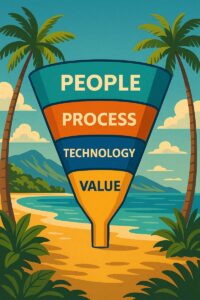
People - mindsets, culture, behaviours


Process - redesign workflows, simplify, automate


Technology - implement enabling systems, platforms, AI


Value - efficiency, service quality, resilience, customer experience
Technology sits in the middle—not at the start. Transformation begins with people and ends with measurable value.
Conclusion
Digital transformation succeeds when organisations put people first. For Caribbean institutions where community, trust, and resilience are deeply embedded, this human dimension becomes a strategic advantage.
Technology will evolve. AI will accelerate. But the organisations that thrive will be the ones that uplift their people, modernise their mindsets, and embed cultures of continuous learning and data-driven decision making.
References
- McKinsey & Company. (2023). The People Power of Transformations.
- Harvard Business Review. (2022). Why Digital Transformations Fail.
- Prosci. (2021). Best Practices in Change Management.
- ESRI. (2023). The Role of Culture in Digital Transformation.
- OECD. (2021). Digital Government Review: People-Driven Transformation.
InfraNova Advisory
Transformation stalls when the human dimension is treated as an afterthought.
InfraNova works with Caribbean governments, state enterprises, and private sector organisations to align people, culture, and capability with digital strategy — so transformation delivers value rather than friction.
Request an executive briefing →