
Across the Caribbean and the wider Commonwealth, organisations are under pressure to do more with less – grow revenue, deepen customer relationships, and upskill teams, all while managing risk. Virtual reality (VR) gives leaders a powerful new lever: an immersive, data-rich channel that can transform how we sell, train, and engage.
Rather than a futuristic gimmick, VR is becoming a practical productivity tool. When used strategically, it can shorten learning curves, differentiate brands, and turn static presentations into experiences that customers and employees actually remember.
How VR Creates Value in Modern Business
1. Immersive Customer Experience and Marketing
VR allows customers to “step into” a brand story – walking through a virtual hotel, exploring a showroom, or experiencing a new product line as if it were physically present. Retailers and consumer brands are already using VR and AR to extend dwell time and create more engaging, visual shopping journeys.
For tourism operators, real-estate developers, universities and service brands, VR campaigns can provide:
- Destination previews and virtual property tours
- Immersive product demonstrations and launch experiences
- Virtual “pop-up” stores and brand activations
Done well, this shifts marketing from “telling” to “letting customers experience”, which typically drives higher conversion and stronger emotional connection to the brand.
2. High-Impact Training and Capability Building
One of the most mature and measurable use cases for VR is training. PwC’s VR Soft Skills Training Efficacy Study found employees in VR courses could be trained up to four times faster than in the classroom, with significantly higher confidence and emotional connection to the content. A broader systematic review also shows VR training is effective for building social, safety, and professional skills across diverse groups of learners.
For organisations, this translates into:
- Reduced time-to-competence for new hires
- Safer practice for high-risk or sensitive scenarios (e.g. emergency response, conflict handling, customer complaints)
- Consistent, standardised training across locations and markets
In practical terms, VR simulations can model everything from branch security incidents to complex service interactions, allowing staff to rehearse decisions repeatedly in a safe, controlled environment.
3. Product Design, Collaboration and Prototyping
VR also supports upstream innovation. Design, engineering, and operations teams can co-create in shared virtual spaces – reviewing plant layouts, branch designs or new digital journeys at full scale before committing capital. This reduces rework, compresses design cycles, and improves cross-functional alignment.
4. Virtual Commerce and Data-Driven Journeys
As immersive and spatial commerce mature, VR is expanding beyond pilots into integrated customer journeys. Retailers are combining VR experiences with analytics platforms to capture behavioural data – how long users interact with specific products, what they explore, and where they drop off.
For SMEs and regional brands, this creates a route to “flagship-level” experiences without flagship-level real-estate costs.
5. Executive Storytelling and Stakeholder Engagement
VR can significantly raise the bar for board and stakeholder engagement. Instead of reviewing flat slide decks, decision-makers can walk through:
- Virtual models of new facilities or smart-city initiatives
- Immersive dashboards visualising operational hotspots
- Simulated citizen or customer journeys in new service models
This matters in an environment where, globally, immersive technologies and the broader “metaverse” are projected by McKinsey to unlock up to USD 5 trillion in value by 2030. Organisations that build internal literacy now will be better positioned for that shift.
Making VR Work in Your Organisation
To move VR from pilot to business-as-usual, leaders should treat it as part of the digital operating model – not a standalone gadget.
- Start with a business problem, not the headset. Anchor VR use cases to specific KPIs: reduced training time, higher NPS, improved sales conversion, or better safety outcomes.
- Prioritise reusable content. Design VR experiences that can be repurposed across multiple campaigns, cohorts, and markets to maximise ROI.
- Use enterprise-grade platforms. Select solutions that support device management, identity and access control, and integration with learning, CRM and analytics systems.
- Embed governance and risk management. Address data protection, health and safety guidelines, accessibility, and content standards as part of your broader ICT and marketing governance framework.
- Measure and iterate. Track engagement, learning outcomes and commercial impact, and use these insights to refine both the experience and the supporting processes.
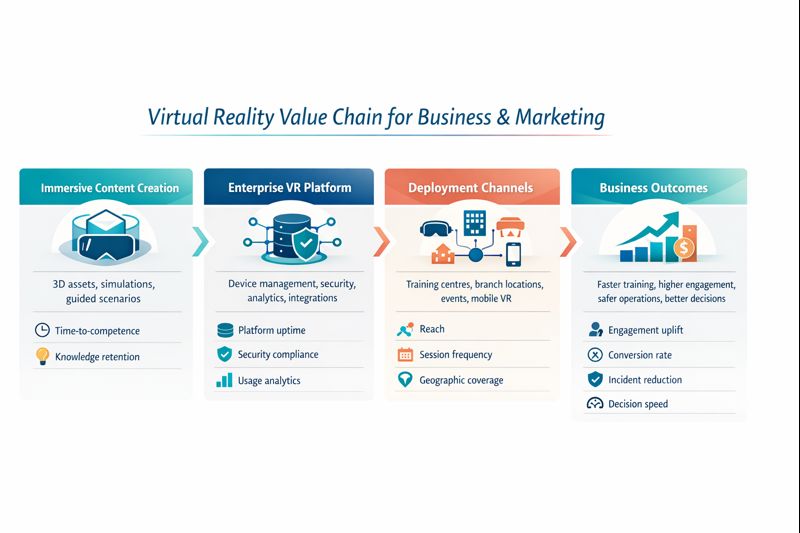
VR Value Chain for Business & Marketing
Related
- PwC. (2020). Solving for skills training with virtual reality.
- PwC. (2022). How virtual reality is redefining soft skills training.
- Radianti, J., et al. (2022). The effectiveness of virtual reality training: A systematic review.
- McKinsey & Company. (2022). What is the metaverse?
- Smart Tribune. (2025). Retail customer experience trends in 2025.