AI Watermarking, the EU AI Act, and Why It Is Not the Proof People Think It Is
Claude can now indicate which parts of content it helped generate, and many other AI systems that institutions rely on can do the same. However, reading the fine print reveals a more complex picture. According to Anthropic’s documentation, a detected watermark is “not fully conclusive.” This means that while it indicates that an AI model was involved in creating the content, it does not provide definitive proof of who originated the ideas. For any Caribbean board, regulatory body, or executive considering a serious digital transformation agenda related to AI, this distinction between indication and proof is crucial.
What Does Claude’s Watermark Actually Do?
Claude’s watermark works through two separate mechanisms, and neither one certifies authorship. An embedded text watermark is woven invisibly into generated text at the model level: it travels with copy and paste, may persist through some light editing, and does not change the meaning, quality or readability of the text. A second mechanism, signed provenance metadata built on the C2PA (Coalition for Content Provenance and Authenticity) open standard, attaches to supported image and vector files (.svg, .png, .jpg) to flag that Claude processed them and to help detect later tampering. Anthropic has signed the EU AI Act’s Article 50(2) Code of Practice on Transparency of AI-Generated Content. Coverage runs worldwide, not EU-only: Claude models launched on or after 2 August 2026 support machine-readable marking at launch, across the Claude Platform (API), Claude.ai, Claude Code, Claude Cowork and Claude Tag, with earlier models being retrofitted. Adobe, Google, Microsoft, Meta and OpenAI build on the same open C2PA standard, so this is an industry mechanic now, not a single vendor’s quirk.
What a Detected Mark Cannot Prove
Anthropic is notably transparent about the limitations of its tool. According to the company, a detected mark indicates that Claude processed the content, but it is not entirely conclusive and does not confirm the content’s full origin. For example, someone may have used Claude solely for proofreading, translating, summarising, or converting an already completed piece of work, and that output would still carry the mark. Furthermore, content can be modified, excerpted, or combined with other material after being marked, and the mark may remain regardless of how much has changed since then.
Conversely, the absence of a detected mark does not provide definitive evidence either. It could simply mean that the model predates marking support, that the text was heavily edited or paraphrased, that the passage was too short to generate a reliable signal, or that file metadata was stripped during conversion or when taking a screenshot.
Anthropic has not yet published its detection tools and plans to do so in forthcoming technical documentation. In summary, a watermark is designed to address a specific question: whether a model interacted with the content. It does not answer the more critical question that institutions are concerned about: how much of the thinking was generated by a machine.
Why Is the EU AI Act Forcing This Now?
Article 50 of the EU AI Act (Regulation (EU) 2024/1689) requires providers of generative AI systems to mark their outputs in a machine-readable, detectable format as artificially generated or manipulated, a duty that took effect on 2 August 2026 regardless of whether the underlying system is classed as high-risk elsewhere in the Act. This is a horizontal transparency rule, not a risk-tier one, and it has the same extraterritorial pull as GDPR: it reaches anyone placing an AI system on the EU market, or whose AI-generated output is used there, regardless of where the company is based. A second, separate duty under Article 50(4) falls on deployers, not just providers: they must disclose deepfakes. They must disclose AI-generated or AI-manipulated text published to inform the public on matters of public interest, unless a named person or organisation has given the content genuine editorial review. A fast-tracked “AI Omnibus” package has since delayed the marking deadline for systems already on the market before 2 August 2026, giving them until 2 December 2026 to comply, a provisional agreement still working through formal adoption at the time of writing. What makes this an industry story rather than a Claude story is the scale of the sign-up: the European Commission’s own count, published 31 July 2026, puts signatories to the underlying Code of Practice at close to 190 organisations, including Anthropic, Google, Meta, Microsoft and OpenAI. For public sector digital transformation in Caribbean programmes and Small Island Developing States digital strategy planning alike, the lesson is the same one GDPR taught: a rule written for Brussels rarely stays there, and institutions that wait for a local mandate before building disclosure practice usually end up retrofitting it under pressure.
Governance catches up to AI faster than most institutions expect.
InfraNova Insights tracks the regulatory and governance shifts that matter to Caribbean boards and public sector leaders, before they become urgent.
Are Third-Party AI Detectors Any More Reliable?
No. Independent research consistently shows that third-party AI detectors, distinct from Anthropic’s own watermarking, misclassify human writing at rates too high to support disciplinary, academic or reputational decisions on their own. A widely cited Stanford study by Liang, Yuksekgonul, Mao, Wu and Zou, published in the journal Patterns, tested seven commercial detectors against 91 genuine TOEFL essays written by non-native English speakers, none of them AI-generated. Nearly 98% were flagged by at least one detector, with an average false positive rate above 61%, because non-native writing tends to have lower linguistic variability, a trait the detectors mistook for machine authorship. A 2025 University of Maryland study by Saha and Feizi found that light AI-assisted polishing of otherwise human-written text pushed detection rates as high as 75%, depending on the tool, meaning minimally edited human writing is routinely misread as AI output. A University of Chicago Booth School of Business working paper by Jabarian and Imas stress-tested detectors on short passages and on text run through AI “humanising” tools, and found accuracy varied enormously by product: one detector held up under pressure, others lost most of their reliability on humanised text, and only one met a strict false-positive threshold suitable for high-stakes use. The consistent thread across all three studies is that hybrid human-AI writing, the ordinary case for most professional work today, is precisely the case every detector struggles with most.
Co-Creation Is Not the Problem, Concealment Is
None of this makes AI-assisted work illegitimate. Used well, AI compresses research, drafting and translation time without replacing judgement, and Caribbean institutions building genuine enterprise data strategy and capability have every reason to use it. The problem was never that a machine touched a document. The problem is when a watermark or a detector’s verdict gets treated as a substitute for someone actually saying what they did and why they stand behind it. That confusion matters most in board-level digital advisory settings and in AI governance and responsible AI Caribbean policy work, where a false sense of technical proof can quietly replace the harder, human work of disclosure.
A watermark can prove a machine touched the words. It cannot prove who is answerable for what they say.
Institutions that get this right tend to treat responsible AI adoption as a designed process, not an afterthought. InfraNova Advisory, a Caribbean-focused digital transformation and ICT strategy advisory firm, uses its own COCOA AI Framework (Create, Organise, Customise, Optimise, Automate) to help clients build exactly that kind of process, one where AI’s role in speeding up delivery is deliberate and governed rather than assumed.
What Is InfraNova’s Trust Receipt, and How Does VVAS Shape It?
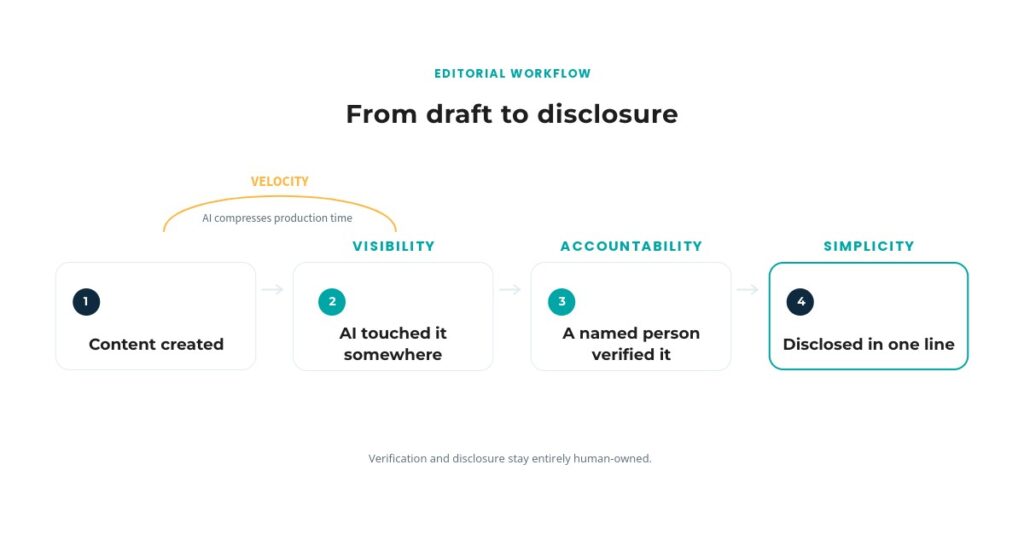
InfraNova’s Trust Receipt is a disclosure standard built on our VVAS principles – Visibility, Velocity, Accountability and Simplicity – and it asks four honest questions before any AI-assisted work goes out under a person’s or an institution’s name.
- Visibility: Say plainly, in the same place the work is delivered, that AI was involved and roughly where. Not a footnote three pages down, and not a vague disclaimer nobody reads.
- Velocity: Name exactly what AI sped up: drafting structure, first-pass research synthesis, translation, formatting, so the reader knows which part of the timeline it actually touched. This is the one deliberate point where VVAS and the COCOA AI Framework meet in our own delivery model: AI’s job is to compress the Velocity stage, never to stand in for the Accountability stage.
- Accountability: Name the person who checked the facts, the sources, the logic and the tone, and who owns the final judgment calls. A model cannot hold this role, no matter how fluent its output reads.
- Simplicity: Keep the disclosure itself short enough to read in ten seconds. A standard nobody reads protects nobody, no matter how well worded.
A watermark answers whether a machine was involved. The Trust Receipt answers the question a watermark was never designed to reach: who is accountable for what was said, and how much of the thinking behind it was theirs.
📚 Recommended Reading
Co-Intelligence: Living and Working with AI by Ethan Mollick (Portfolio/Penguin, 2024). Mollick, a Wharton professor who studies AI’s effect on work, makes the case that the most useful frame for professionals is neither “AI wrote this” nor “AI had no part in this,” but a disciplined middle ground he calls co-intelligence: humans and AI working as genuine collaborators, each doing what they do best. For a Caribbean executive or public sector leader deciding how openly to disclose AI use, it offers a useful corrective to both extremes: the manager who hides AI assistance out of embarrassment and the one who treats a tool’s output as automatically authoritative. It sits comfortably alongside InfraNova’s own view that co-creation, openly disclosed, is a legitimate and often better way of working.
What This Means for Caribbean Boards and Professionals
The EU AI Act will not be the last regulation to treat machine-readable marking as good practice, and it will not be the last one Caribbean institutions read about only after it has already reshaped the tools they use daily. Building disclosure habits now, ahead of a local mandate, is what separates a trusted digital transformation advisor’s client base from institutions still reacting to rules written somewhere else. That is the real opportunity in a governance-led digital transformation approach: not waiting for Small Island Developing States digital strategy frameworks to catch up before deciding how honest to be about AI’s role in your own work. The watermark shows that AI was involved somewhere. Disclosing who thought, and who answers for it, is still on us. That hasn’t changed, and it isn’t going to.
Transparency note: This article was researched and drafted with AI assistance under InfraNova Advisory’s editorial governance process. Every factual claim is verified against primary sources before publication, and the analysis, positions and recommendations are InfraNova Advisory’s own. We advise organisations on responsible AI adoption, and we hold our own publishing to the same standard: disclosed, governed and human-accountable.
InfraNova Advisory
A watermark tells you AI was involved. We help you build the governance that says who is accountable for it.
InfraNova Advisory designs AI governance and disclosure standards for Caribbean boards, regulators and enterprises, grounded in our COCOA AI Framework and built for institutional digital modernisation, not just compliance paperwork. If your organisation is adopting AI faster than its governance is keeping up, that gap is exactly where we work.