
Across the Caribbean, conversations about artificial intelligence often arrive with big promises and even bigger uncertainty. In Trinidad and Tobago, productivity pressures, citizen expectations, and fiscal constraints are converging in ways that make technology adoption less about experimentation and more about necessity. Against this backdrop, Trinidad and Tobago’s participation in the OpenAI Edu initiative represents a meaningful inflection point, one that signals intent to move from curiosity to capability.
This is not about chasing trends. It is about building institutional competence, strengthening decision intelligence, and ensuring that AI adoption in the public service is governance-led, risk-aware, and grounded in local realities.
What Is OpenAI Edu and Why It Matters
OpenAI Edu is an education-focused programme developed by OpenAI to support governments, universities, and public institutions in building practical AI literacy and applied capability. The programme goes beyond basic awareness. It focuses on structured learning, hands-on use cases, and institutional readiness for deploying generative AI tools responsibly.
For the public sector, this matters because AI adoption is rarely a technology problem. It is an operating model challenge. OpenAI Edu provides access to curated learning resources, policy-aligned guidance, and applied examples that help institutions understand where AI adds value, where it introduces risk, and how to embed it into everyday workflows without undermining accountability.
From Tools to Outcomes in the Public Service
The long-term value of AI in government is not automation for its own sake. It is decision quality. In Caribbean public institutions, many challenges stem from fragmented data, manual processes, and limited analytical capacity. AI, when paired with strong data foundations, enables faster insight generation, scenario analysis, and evidence-based policy formulation.
Practical applications already within reach include intelligent document processing for permits and licences, predictive analytics for revenue assurance, and AI-assisted drafting of policy briefs that free senior officers to focus on judgement rather than compilation. These use cases align directly with decision intelligence consulting and ICT governance advisory priorities across the region.
Governance First, Not Last
A recurring risk in global AI adoption is the rush to deploy tools without clear governance. In small island states, this risk is amplified by regulatory obligations, data protection requirements, and limited tolerance for failure. OpenAI Edu places early emphasis on responsible use, transparency, and human oversight.
For Caribbean governments, this supports a governance-led digital transformation approach. AI systems must be auditable, aligned with procurement and ICT policies, and clearly accountable within existing operating models. This is where AI governance and responsible AI frameworks become enablers rather than constraints.
The Caribbean Context: What We Know So Far
At the time of writing, Trinidad and Tobago’s participation in OpenAI Edu stands out as a clearly articulated national-level signal. Publicly available information on formal participation by other Caribbean states remains limited. However, several regional governments and universities have engaged in AI capacity-building through multilateral programmes, academic partnerships, and pilot projects focused on data analytics and digital public services.
This pattern suggests an emerging pathway rather than an outlier. As Caribbean governments observe practical outcomes such as improved service turnaround times, better analytics for budgeting, and enhanced institutional learning, structured programmes like OpenAI Edu are likely to gain traction across the region.
Long-Term Value for Public Institutions
The strategic payoff of AI in the public service is cumulative. Over time, institutions develop shared data assets, repeatable analytical models, and staff who are confident using AI as a decision support tool. This maturity supports institutional digital modernisation, strengthens board-level oversight, and improves trust through more consistent service delivery.
For Caribbean governments, the real return is resilience. AI-enabled institutions are better equipped to respond to economic shocks, climate events, and demographic change with speed and insight rather than reaction.
Recommended Reading
Prediction Machines by Ajay Agrawal, Joshua Gans, and Avi Goldfarb offers a clear, accessible explanation of how cheaper and faster prediction changes organisational decision-making. Rather than focusing on technology, the book explores how AI reshapes workflows, incentives, and governance, making it highly relevant for public sector leaders navigating AI adoption.
From Concept to Practice
One practical way public institutions can operationalise AI responsibly is by embedding it within existing analytics pipelines. For example, AI-assisted analysis can sit alongside traditional reporting rather than replacing it.
A Practical Example: AI-assisted policy analysis workflow
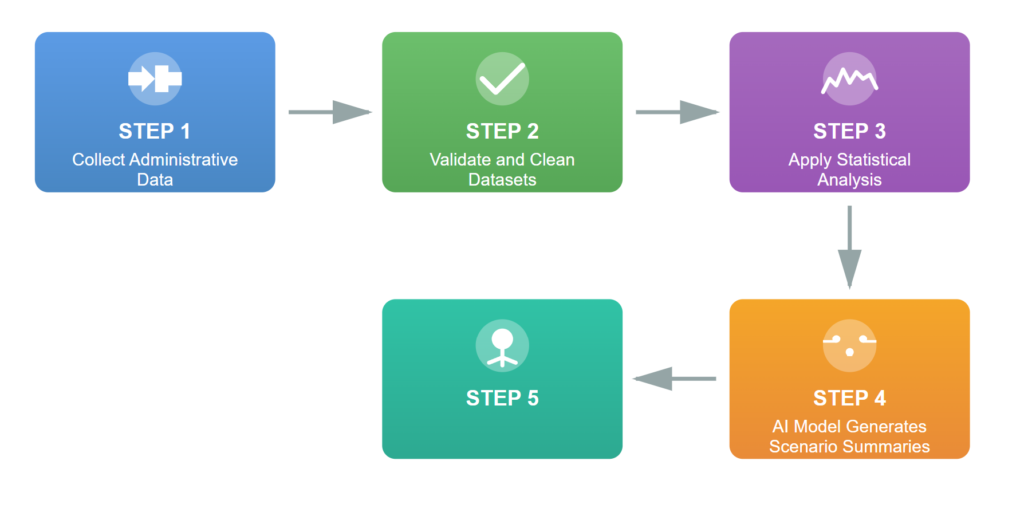
This hybrid approach preserves accountability while accelerating insight, a principle that underpins effective public sector AI use.
Conclusion
Trinidad and Tobago’s engagement with OpenAI Edu is best understood as a capability investment, not a technology purchase. It signals a shift toward governance-led, decision-focused AI adoption in the public service. For the wider Caribbean, it offers a reference point for moving beyond hype and toward applied, responsible, and regionally grounded digital transformation.
References
- OpenAI. (2024). OpenAI Education Initiatives.
- Agrawal, A., Gans, J., & Goldfarb, A. (2018). Prediction Machines. Harvard Business Review Press.
- OECD. (2023). AI in the Public Sector.
- World Bank. (2022). GovTech and Digital Government in Small States.
- UN ECLAC. (2023). Digital Transformation in the Caribbean.